Showing posts with label Unemployment. Show all posts
Showing posts with label Unemployment. Show all posts
Tuesday, April 12, 2016

Monday, April 11, 2016
Let's Get Fiscal
My talk to parliamentarians from around the globe. Yes, (the Bank-Fund) Spring (Meeting) has sprung.


Friday, March 4, 2016
Sharing the Growth Dividend: Analysis of Inequality in Asia
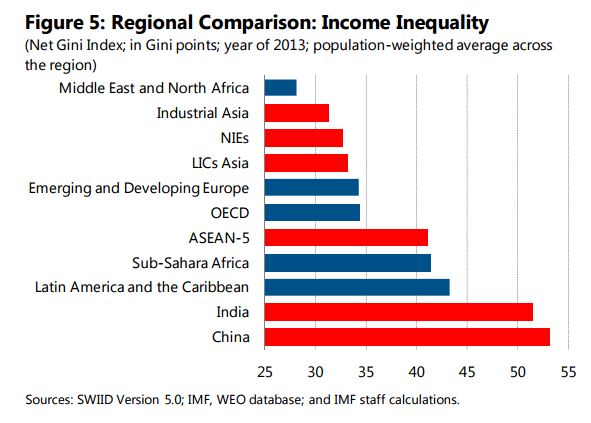
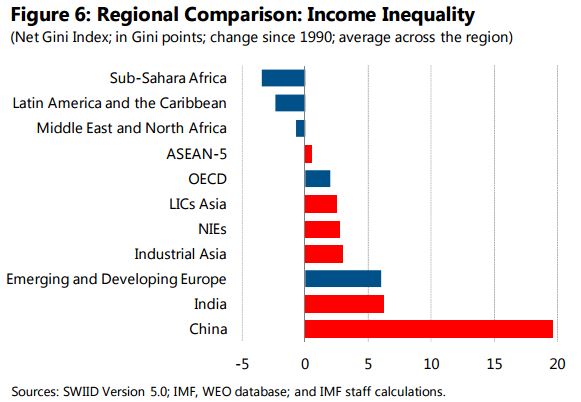
A new IMF "paper focuses on income inequality in Asia, its drivers and policies to combat it. It finds that income inequality has risen in most of Asia, in contrast to many regions. While in the past, rapid growth in Asia has come with equitable distribution of the gains, more recently fast-growing Asian economies have been unable to replicate the “growth with equity” miracle. There is a growing consensus that high levels of inequality can hamper the pace and sustainability of growth. The paper argues that policies could have a substantial effect on reversing the trend of rising inequality. It is imperative to address inequality of opportunities, in particular to broaden access to education, health, and financial services. Also fiscal policy could combat rising inequality, including by expanding and broadening the coverage of social spending, improving tax progressivity, and boosting compliance. Further efforts to promote financial inclusion, while maintaining financial stability, can help."
Thursday, February 25, 2016
Inequality and opening up to foreign capital and inequality: some new results
After countries remove restrictions on capital flows, inequality often gets worse
In June 1979, shortly after winning a landmark election, Margaret Thatcher eliminated restrictions on “the ability to move money in and out” of the United Kingdom, which some of her supporters regard as “one of her best and most revolutionary acts” (Heath, 2015).
Thatcher’s critics [have] regarded this same liberalization as starting a global trend whose “downside . . . proved to be painful” (Schiffrin, 2016). In their view, while the free mobility of capital across national borders confers many benefits in theory, in practice liberalization has often led to economic volatility and financial crisis. This in turn has adverse consequences for many in the economy, particularly for those who are not well off. Liberalization also affects the relative bargaining power of companies and workers (that is, of capital and labor, respectively, in the jargon of economists) because capital is generally able to move across national boundaries with greater ease than labor. The threat of being able to move production abroad reduces labor’s bargaining power and the share of the income pie that goes to workers.
In studying such distributional effects of capital account liberalization, Davide Furceri and I found that after countries take steps to open their capital account, an increase in inequality in incomes within countries follows (Furceri and Loungani, 2015). The impact is greater when liberalization is followed by a financial crisis and in countries where there is low financial development—that is, where financial institutions are small and access to these institutions is limited. We also find that the share of income going to labor declines in the aftermath of liberalization. Thus, like trade liberalization, capital account liberalization can lead to winners and losers. But while the distributional effects of trade have long been studied by economists, the distributional impacts of opening the capital account are just starting to be analyzed.
Read the rest of this (non-technical) summary of our results here: http://www.imf.org/external/pubs/ft/fandd/2016/03/furceri.htm
Here’s a link to the IMF Working Paper: http://www.imf.org/external/pubs/ft/wp/2015/wp15243.pdf
Earlier versions of this research, based on data for advanced economies, were featured on Krugman’s blog and in VoxEU. These new results extend our results to developing economies as well as lay out possible channels through which capital account liberalization leads to inequality.
In June 1979, shortly after winning a landmark election, Margaret Thatcher eliminated restrictions on “the ability to move money in and out” of the United Kingdom, which some of her supporters regard as “one of her best and most revolutionary acts” (Heath, 2015).
Thatcher’s critics [have] regarded this same liberalization as starting a global trend whose “downside . . . proved to be painful” (Schiffrin, 2016). In their view, while the free mobility of capital across national borders confers many benefits in theory, in practice liberalization has often led to economic volatility and financial crisis. This in turn has adverse consequences for many in the economy, particularly for those who are not well off. Liberalization also affects the relative bargaining power of companies and workers (that is, of capital and labor, respectively, in the jargon of economists) because capital is generally able to move across national boundaries with greater ease than labor. The threat of being able to move production abroad reduces labor’s bargaining power and the share of the income pie that goes to workers.
In studying such distributional effects of capital account liberalization, Davide Furceri and I found that after countries take steps to open their capital account, an increase in inequality in incomes within countries follows (Furceri and Loungani, 2015). The impact is greater when liberalization is followed by a financial crisis and in countries where there is low financial development—that is, where financial institutions are small and access to these institutions is limited. We also find that the share of income going to labor declines in the aftermath of liberalization. Thus, like trade liberalization, capital account liberalization can lead to winners and losers. But while the distributional effects of trade have long been studied by economists, the distributional impacts of opening the capital account are just starting to be analyzed.
Read the rest of this (non-technical) summary of our results here: http://www.imf.org/external/pubs/ft/fandd/2016/03/furceri.htm
Here’s a link to the IMF Working Paper: http://www.imf.org/external/pubs/ft/wp/2015/wp15243.pdf
Earlier versions of this research, based on data for advanced economies, were featured on Krugman’s blog and in VoxEU. These new results extend our results to developing economies as well as lay out possible channels through which capital account liberalization leads to inequality.
Tuesday, February 23, 2016
Financial Development, Inequality and Poverty: Some International Evidence
A new IMF paper by Sami Ben Naceur and RuiXin Zhang "(...) provides evidence on the link between financial development and income distribution. Several dimensions of financial development are considered: financial access, efficiency, stability, and liberalization. Each aspect is represented by two indicators: one related to financial institutions, and the other to financial markets. Using a sample of 143 countries from 1961 to 2011, the paper finds that four of the five dimensions of financial development can significantly reduce income inequality and poverty, except financial liberalization, which tends to exacerbate them. Also, banking sector development tends to provide a more significant impact on changing income distribution than stock market development. Together, these findings are consistent with the view that macroeconomic stability and reforms that strengthen creditor rights, contract enforcement, and financial institution regulation are needed to ensure that financial development and liberalization fully support the reduction of poverty and income equality."
Here are some of my previous posts on capital account liberalization and inequality.
Friday, February 19, 2016
The IMF’s Interest in Inclusive Growth: Promising or PR?
My presentation today at CIGI tries to provide a framework for the IMF's various recent policy forays and some of the key changes in IMF advice.
Friday, January 29, 2016
The Unemployment Picture in 2016
From the International Jobs Report--January 2016
Figure 1 provides a measure of the global unemployment rate based on data for 116 countries, of which 37 countries are classified as ‘advanced’ (i.e. high-income) countries and the remaining 79 as ‘emerging market and developing economies.’ (We refer to the second group using the acronym ‘EMDE’.)

Let’s begin with how the global unemployment picture looked before the IMF’s January 2016 WEO Update. Figure 1 provides a measure of the global unemployment rate based on data for 116 countries, of which 37 countries are classified as ‘advanced’ (i.e. high-income) countries and the remaining 79 as ‘emerging market and developing economies.’ (We refer to the second group using the acronym ‘EMDE’.) Focusing on the recent cycle, global unemployment rate peaked in 6.2 percent in 2009 and has since been returning slowly to its pre-crisis level. Over the coming year, the global unemployment rate is expected to go up slightly.
To understand where this increase is coming from, Figure 2 shows the unemployment rate for the two main groups of countries separately. This reveals that the increase comes from the emerging markets and developing countries (EMDE) group. Moreover, the increase in unemployment among this group occurs because of the expected increase in unemployment among fuelexporting countries (Figure 3).

How will the growth revisions affect the unemployment picture?
Now let’s consider how the revisions to the growth forecasts that the IMF announced in the January 2016 WEO Update could change the unemployment picture. At the global level, the forecast for GDP growth in 2016 was revised down by 0.2 percent, which would in turn increase the global unemployment rate only a little bit above the path projected in Figure 1. However, for some countries the revisions in growth forecasts are larger, as shown in Figure 4 below. The biggest change is in Brazil, followed by Saudi Arabia, South Africa and Russia.

Monday, November 30, 2015
Labor Migration across U.S. States: An Update
A high degree of mobility has long been considered a distinguishing feature of the U.S. labor market.
A commonly-held view is that when a U.S. state is experiencing tough times (relative to other U.S. states), workers quickly leave the state for greener pastures; this keeps the state’s unemployment rate from going up too much and its labor force participation rate from declining too much.
My new work (with Mai Dao and Davide Furceri) offers a less sanguine view of the ability of U.S. workers to shield themselves from the consequences of adverse shocks. We show that, particularly in the short run, the adjustment to tough times occurs more through unemployment rates going up than through people leaving the state. And while migration picks up during recessions, people in the states that are doing very poorly have a difficult time exiting.
Here is a link to the paper and a technical summary of the paper:
Our first key finding is that labor mobility is less important as a cyclical adjustment mechanism, relative to changes in unemployment and participation, than suggested in earlier work. Some of this shift in view comes from the addition of over 20 years of data to the previous work. But the main reason is that, given the availability of official interstate net-migration data starting in 1991 we can also directly look at the behavior of migration, as opposed to backing it out as a residual. We find that it is primarily the relative unemployment rate, not net migration, that is the main adjustment mechanism in the first two years following a relative shock to state labor demand.
Our second set of findings pertains to a newer literature that documents longer-run movements in U.S. mobility, particularly the steady and widespread reduction in gross internal migration rates since the 1980’s. Here we establish several results that reveal important patterns in regional adjustment mechanisms.
A commonly-held view is that when a U.S. state is experiencing tough times (relative to other U.S. states), workers quickly leave the state for greener pastures; this keeps the state’s unemployment rate from going up too much and its labor force participation rate from declining too much.
My new work (with Mai Dao and Davide Furceri) offers a less sanguine view of the ability of U.S. workers to shield themselves from the consequences of adverse shocks. We show that, particularly in the short run, the adjustment to tough times occurs more through unemployment rates going up than through people leaving the state. And while migration picks up during recessions, people in the states that are doing very poorly have a difficult time exiting.
Here is a link to the paper and a technical summary of the paper:
Our first key finding is that labor mobility is less important as a cyclical adjustment mechanism, relative to changes in unemployment and participation, than suggested in earlier work. Some of this shift in view comes from the addition of over 20 years of data to the previous work. But the main reason is that, given the availability of official interstate net-migration data starting in 1991 we can also directly look at the behavior of migration, as opposed to backing it out as a residual. We find that it is primarily the relative unemployment rate, not net migration, that is the main adjustment mechanism in the first two years following a relative shock to state labor demand.
Our second set of findings pertains to a newer literature that documents longer-run movements in U.S. mobility, particularly the steady and widespread reduction in gross internal migration rates since the 1980’s. Here we establish several results that reveal important patterns in regional adjustment mechanisms.
- First, in the last two decades or so starting 1990, the response of net migration to given regional shocks in the short run has decreased, as has the response of relative unemployment and participation rates, resulting in less dispersion of employment growth in response to given dispersion in relative labor demand shocks.
- Second, the smaller migration response to shocks is driven entirely by less net out-migration from states that experience adverse labor demand shifts, whereas the net in-migration response to states with favorable labor demand shifts has increased or remained constant (depending on time horizon). This also suggests that in-migrants to the best states do not disproportionately come from the poorest states, a sign of lack of migration directedness and of scope for efficiency gains from an aggregate perspective.
- Third, despite the trend decline in gross migration rates since the early 1990’s, the migration response to a state-relative demand shock increases strongly in recessions, hence potentially playing a larger role as shock absorber during aggregate downturns than in normal times. Importantly, we observe that this counter-cyclical response of migration is driven primarily by a stronger response of positive net migration into states that do relatively better during recessions, while negative net migration from states that do relatively worse only increases by less and the response is delayed, occurring toward the end of the recession. When a state like North Dakota does relatively better than average during a recession thanks to the shale gas boom, it attracts disproportionately more in-migration than for instance Texas during an expansion, when strong demand for oil creates more jobs in Texas than elsewhere. However, the migrants into North Dakota during the recession do not come disproportionately more from states that are doing worse than average, say Michigan, as one would expect.
Fund Fires Employment Guru?
So, did the Fund fire its employment guru? Well, not quite, but after five years at the helm of the Fund’s Jobs & Growth working group, Prakash Loungani is moving on to other assignments. RES GESTAE spoke to him about the group’s travails in promoting the Fund’s work on jobs, growth and equity.

RG: What was the group set up to do?
Loungani: On jobs, the immediate task was to remind people that sometimes unemployment is high because demand is low. The Fund, like many others, often veers towards thinking of unemployment as largely a supply-side problem—people are lazy or we give them very generous unemployment benefits so they don’t search for jobs or there are structural problems that keep unemployment high. At the onset of the Great Recession, Olivier (Blanchard) and Min (Zhu)—who had oversight over the group—were worried that we would underplay the most obvious explanation for why unemployment had spiked up, namely that aggregate demand had fallen. Our mission was to keep the words “aggregate demand” alive within the building and outside.
RG: Did you succeed?
Loungani: Perhaps more outside the building than within it, at least initially. Under Olivier’s supervision—he gave me a two-page outline and said “follow this”—Mai Dao and I wrote a 2010 paper which Paul Krugman praised: “A recovery in aggregate demand is the single best cure for unemployment. What a relief to hear the IMF say that!” This sentiment was echoed by many others over the ensuing years, including many in the trade union movement. We had a tougher time at other institutions: after one of my presentations in Europe a person came up to me and said: “I heard the same thing from Olivier 30 years ago and I didn’t believe it then.”
RG: And within the Fund building?
Loungani: It has been a tough sell. Larry Ball (of Johns Hopkins), Davide Furceri, Daniel Leigh and I kept up a drumbeat that the short-run relationship between output and unemployment—known as Okun’s Law—had remained stable through the Great Recession. Antonio Spilimbergo started calling us the “Okun police”. I think it eventually started to rub off; one piece of evidence is EUR’s paper on the rise in youth unemployment, which provides an even-handed treatment of the respective roles of aggregate demand and supply factors.
RG: What was the task on growth?
Loungani: Olivier put it as “moving beyond mantras”. Both he and I had the view that the Fund goes to countries and says: “Here are 25 (structural) areas on which you are behind international standards. Improve on all them by next year and you will surely grow”. So I started to look through the Fund’s advice on growth.
RG: What did you find?
Loungani: That the characterization is unfair. Though you can still find examples of the kind I mentioned, the bulk of the Fund’s advice on growth is actually quite ‘granular’; that is, it digs down to see the specific problems the country is facing. Think, for example, of the great work that Patrizia Tumbarello and many other Fund staff have done in providing advice to small states on sustainable growth.
RG: So what did the group do?
Loungani: In the “Jobs & Growth” Board paper, we summarized the current ‘do’s and don’ts’ on growth and then showed that staff had been broadly following that advice. We also issued a very nice guidance note for Fund staff on how to tackle growth issues—I am not praising myself here as this was largely the work of several SPR colleagues. In this case too, as with jobs, we got some external recognition—in this case some back-handed praise from Dani Rodrik, who in the past has been critical of our advice on growth.
RG: And, finally, on inequality?
Loungani: Here the guidance came largely from Min (Zhu), at least initially. Around 2010-11, when the group’s work started, Min was more concerned about inequality than was Olivier. Min said we should see how policies, including Fund policies, affect inequality, so we could take these effects into account in our surveillance and program work.
RG: So does Fund policy advice affect inequality?
Loungani: One of the first things we did was to see how fiscal consolidations—referred to as ‘austerity’ outside our building—affected inequality. In a 2011 piece we found that austerity raises inequality. This initially proved controversial within the building—and, not surprisingly, popular in some circles outside—but management supported us and the paper was published. In 2014, FAD did a very nice Board paper on fiscal policy and inequality and has just issued a new book on the topic. Recently we have shown that openness—capital account liberalization—raises inequality; I hope MCM picks up on this, the way FAD did with fiscal policy. Min also wanted us to see how monetary and exchange rate policies affect inequality; I never got around to it but hope springs eternal—here again MCM could help.
RG: What’s next for you?
Loungani: I have a few residual tasks to complete in the Jobs & Growth agenda. One is to finish extensions of the work on Okun’s Law to emerging markets and low-income countries. The other is to think about the advice the Fund gives to these countries on the design of labor market institutions. This was a topic close to Olivier’s and my hearts; but while Olivier and I did a paper on it for advanced economies (with Florence Jaumotte), I never got around to doing the follow-up paper for other countries. But my main job is to head the division within RES that deals with low-income countries.
RG: And what’s next for the group? Is it disbanded and how would you summarize its impact?
Loungani: Well, my co-chair Ranil Salgado and I have both moved on. But the agenda continues under new management—and the seminar series we launched continues as well. In RES, Romain Duval has taken over and had added structural reforms to the agenda—this is good as the focus we had placed on aggregate demand was appropriate for the time but we should be even-handed. And of course, inequality has become a big deal at the Fund now—with the astounding success of the work by Jonathan Ostry and Andy Berg, the blossoming work on gender inequality, the pilot cases on operationalizating inequality.
On the impact: I suspect Gerry Rice would not call it “huge”. But, in the words of the poet, we managed “to swell a progress, start a scene or two.”

RG: What was the group set up to do?
Loungani: On jobs, the immediate task was to remind people that sometimes unemployment is high because demand is low. The Fund, like many others, often veers towards thinking of unemployment as largely a supply-side problem—people are lazy or we give them very generous unemployment benefits so they don’t search for jobs or there are structural problems that keep unemployment high. At the onset of the Great Recession, Olivier (Blanchard) and Min (Zhu)—who had oversight over the group—were worried that we would underplay the most obvious explanation for why unemployment had spiked up, namely that aggregate demand had fallen. Our mission was to keep the words “aggregate demand” alive within the building and outside.
RG: Did you succeed?
Loungani: Perhaps more outside the building than within it, at least initially. Under Olivier’s supervision—he gave me a two-page outline and said “follow this”—Mai Dao and I wrote a 2010 paper which Paul Krugman praised: “A recovery in aggregate demand is the single best cure for unemployment. What a relief to hear the IMF say that!” This sentiment was echoed by many others over the ensuing years, including many in the trade union movement. We had a tougher time at other institutions: after one of my presentations in Europe a person came up to me and said: “I heard the same thing from Olivier 30 years ago and I didn’t believe it then.”
RG: And within the Fund building?
Loungani: It has been a tough sell. Larry Ball (of Johns Hopkins), Davide Furceri, Daniel Leigh and I kept up a drumbeat that the short-run relationship between output and unemployment—known as Okun’s Law—had remained stable through the Great Recession. Antonio Spilimbergo started calling us the “Okun police”. I think it eventually started to rub off; one piece of evidence is EUR’s paper on the rise in youth unemployment, which provides an even-handed treatment of the respective roles of aggregate demand and supply factors.
RG: What was the task on growth?
Loungani: Olivier put it as “moving beyond mantras”. Both he and I had the view that the Fund goes to countries and says: “Here are 25 (structural) areas on which you are behind international standards. Improve on all them by next year and you will surely grow”. So I started to look through the Fund’s advice on growth.
RG: What did you find?
Loungani: That the characterization is unfair. Though you can still find examples of the kind I mentioned, the bulk of the Fund’s advice on growth is actually quite ‘granular’; that is, it digs down to see the specific problems the country is facing. Think, for example, of the great work that Patrizia Tumbarello and many other Fund staff have done in providing advice to small states on sustainable growth.
RG: So what did the group do?
Loungani: In the “Jobs & Growth” Board paper, we summarized the current ‘do’s and don’ts’ on growth and then showed that staff had been broadly following that advice. We also issued a very nice guidance note for Fund staff on how to tackle growth issues—I am not praising myself here as this was largely the work of several SPR colleagues. In this case too, as with jobs, we got some external recognition—in this case some back-handed praise from Dani Rodrik, who in the past has been critical of our advice on growth.
RG: And, finally, on inequality?
Loungani: Here the guidance came largely from Min (Zhu), at least initially. Around 2010-11, when the group’s work started, Min was more concerned about inequality than was Olivier. Min said we should see how policies, including Fund policies, affect inequality, so we could take these effects into account in our surveillance and program work.
RG: So does Fund policy advice affect inequality?
Loungani: One of the first things we did was to see how fiscal consolidations—referred to as ‘austerity’ outside our building—affected inequality. In a 2011 piece we found that austerity raises inequality. This initially proved controversial within the building—and, not surprisingly, popular in some circles outside—but management supported us and the paper was published. In 2014, FAD did a very nice Board paper on fiscal policy and inequality and has just issued a new book on the topic. Recently we have shown that openness—capital account liberalization—raises inequality; I hope MCM picks up on this, the way FAD did with fiscal policy. Min also wanted us to see how monetary and exchange rate policies affect inequality; I never got around to it but hope springs eternal—here again MCM could help.
RG: What’s next for you?
Loungani: I have a few residual tasks to complete in the Jobs & Growth agenda. One is to finish extensions of the work on Okun’s Law to emerging markets and low-income countries. The other is to think about the advice the Fund gives to these countries on the design of labor market institutions. This was a topic close to Olivier’s and my hearts; but while Olivier and I did a paper on it for advanced economies (with Florence Jaumotte), I never got around to doing the follow-up paper for other countries. But my main job is to head the division within RES that deals with low-income countries.
RG: And what’s next for the group? Is it disbanded and how would you summarize its impact?
Loungani: Well, my co-chair Ranil Salgado and I have both moved on. But the agenda continues under new management—and the seminar series we launched continues as well. In RES, Romain Duval has taken over and had added structural reforms to the agenda—this is good as the focus we had placed on aggregate demand was appropriate for the time but we should be even-handed. And of course, inequality has become a big deal at the Fund now—with the astounding success of the work by Jonathan Ostry and Andy Berg, the blossoming work on gender inequality, the pilot cases on operationalizating inequality.
On the impact: I suspect Gerry Rice would not call it “huge”. But, in the words of the poet, we managed “to swell a progress, start a scene or two.”
Tuesday, November 24, 2015
IMF's Thanksgiving message: ensure benefits of foreign capital are shared broadly
Opening up capital markets, unless managed well, can raise inequality. That’s the message of a new working paper by Davide Furceri and me that the IMF released today. Paul Krugman, based on the early evidence from our work, wrote:
“Davide Furceri and Prakash Loungani use an event-study framework — looking at what happens on average after clear changes in policy — to assess the effects of “neoliberal” policy changes (although they don’t put it that way) on inequality. Sure enough, they find that both fiscal austerity and liberalization of international capital movements are followed by noticeable rises in income inequality. So, if you were a ranting leftist, you might say that political attitudes are shaped by class, and that ideological justifications for high inequality are just a veil for class interest. You might also say that “sound” economic policies are really just policies that redistribute income upwards. And it turns out that the econometric evidence more or less supports your rant.”
Well, our evidence holds up to further scrutiny. And the conclusions we’d like you to draw from our work are summarized in our new blog. And then, if you really want to get a break from the in-laws, here’s the paper. Nothing clears the living room better than a statement like “Guys, let me tell you about this fascinating paper – its findings do not imply that countries should not undertake capital account liberalization, but it suggests an additional reason for caution.”
Happy Thanksgiving,
Prakash
“Davide Furceri and Prakash Loungani use an event-study framework — looking at what happens on average after clear changes in policy — to assess the effects of “neoliberal” policy changes (although they don’t put it that way) on inequality. Sure enough, they find that both fiscal austerity and liberalization of international capital movements are followed by noticeable rises in income inequality. So, if you were a ranting leftist, you might say that political attitudes are shaped by class, and that ideological justifications for high inequality are just a veil for class interest. You might also say that “sound” economic policies are really just policies that redistribute income upwards. And it turns out that the econometric evidence more or less supports your rant.”
Well, our evidence holds up to further scrutiny. And the conclusions we’d like you to draw from our work are summarized in our new blog. And then, if you really want to get a break from the in-laws, here’s the paper. Nothing clears the living room better than a statement like “Guys, let me tell you about this fascinating paper – its findings do not imply that countries should not undertake capital account liberalization, but it suggests an additional reason for caution.”
Happy Thanksgiving,
Prakash
Tuesday, November 17, 2015
Effects of Wage Moderation in the Euro Area
A devaluation is often a way out of financial trouble for a country. But for many crisis-hit countries in the euro area, devaluation is not an option. ‘Internal’ devaluation—through wage moderation, for instance—is often discussed as an alternative solution for these countries to try to mimic the outcomes of an external devaluation. When does such internal devaluation work? My new IMF paper provides evidence on this using the euro area countries as an illustration. The main finding is that for wage moderation to work when a number of countries are undertaking it at the same time, strong support is needed from monetary policy in the form of quantitative easing. The paper shows that when one crisis-hit euro area country pursues wage moderation, it stands to gain in terms of an increase in its output. But when a few crisis-hit euro area countries pursue wage moderation at the same time, the benefits to each one decline; moreover, the collective wage moderation by the group has adverse spillovers on the other euro area countries, so that euro area output as a whole declines. Quantitative easing by the central bank can offset the decline in euro area output. Here is a blog that summarizes the paper and here is the paper itself.


Thursday, November 5, 2015
Tuesday, October 27, 2015
On U.S. Labor Market Slack: Updated Estimates of the Impact of Uncertainty on Unemployment
Is uncertainty contributing to U.S. unemployment at present? Based on updated estimates of my work with Sam Choi the answer is “no”. Our measures of aggregate uncertainty and sectoral uncertainty are both back to pre-crisis levels and their contribution to unemployment has dwindled to zero. The chart below shows a baseline projection for unemployment (the portion shown in blue) and then adds on the contribution of other factors to get to the actual unemployment rate.
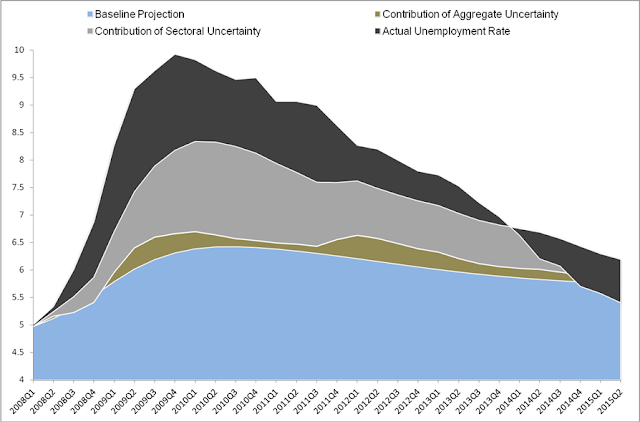
We find that aggregate uncertainty contributed a bit to unemployment in 2009 and again in 2012 (this is the portion of the chart shown in brown). Our aggregate uncertainty measure is the realized volatility of S&P 500 index returns, similar to Bloom (2009).
Our sectoral uncertainty measure is the cross-section dispersion in excess returns across various industries. We show in our paper that this measure of uncertainty tends to have more persistent impacts on unemployment than aggregate uncertainty. The contribution of sectoral uncertainty to U.S. unemployment was important in mid-2010—this was the result that Bob Samuelson cited in his column at the time. But the contribution of sectoral uncertainty has declined steadily ever since and is essentially zero at present. (This is the portion of the chart shown in grey.)
The main reason for the decline in unemployment is the resumption of growth and unemployment’s own dynamics; their contribution is shown as part of the other factors in the chart above (the portion shown in black).
Details are provided in our paper. Please note that as in other IMF working papers, the views expressed in this paper are those of the authors and should not be ascribed to the IMF.

We find that aggregate uncertainty contributed a bit to unemployment in 2009 and again in 2012 (this is the portion of the chart shown in brown). Our aggregate uncertainty measure is the realized volatility of S&P 500 index returns, similar to Bloom (2009).
Our sectoral uncertainty measure is the cross-section dispersion in excess returns across various industries. We show in our paper that this measure of uncertainty tends to have more persistent impacts on unemployment than aggregate uncertainty. The contribution of sectoral uncertainty to U.S. unemployment was important in mid-2010—this was the result that Bob Samuelson cited in his column at the time. But the contribution of sectoral uncertainty has declined steadily ever since and is essentially zero at present. (This is the portion of the chart shown in grey.)
The main reason for the decline in unemployment is the resumption of growth and unemployment’s own dynamics; their contribution is shown as part of the other factors in the chart above (the portion shown in black).
Details are provided in our paper. Please note that as in other IMF working papers, the views expressed in this paper are those of the authors and should not be ascribed to the IMF.
Thursday, October 22, 2015
Union power and inequality
From VoxEU:
Inequality in advanced economies has risen considerably since the 1980s, largely driven by the increase of top earners’ income shares. This column [by Florence Jaumotte and Carolina Osorio Buitron (both at the IMF)] revisits the drivers of inequality, emphasising the role played by changes in labour market institutions. It argues that the decline in union density has been strongly associated with the rise of top income inequality and discusses the multiple channels through which unionisation matters for income distribution.
Revisiting the drivers of inequality: The role of labour market institutions
Rising inequality in advanced economies, in particular at the top of the distribution, has become a great focus of attention for economists and policymakers. In most advanced economies, the share of income accruing to the top 10% earners has increased at the expense of all other income groups (Figure 1). While some inequality can increase efficiency by strengthening incentives to work and invest, recent research suggests that high inequality is associated with lower and less sustainable growth in the medium run (Berg and Ostry 2011, Dabla-Norris et al. 2015). Moreover, a rising concentration of income at the top of the distribution can also reduce welfare by allowing top earners to manipulate the economic and political system in their favour (Stiglitz 2012).
Traditional explanations for the rise of inequality in advanced economies have been skill-biased technological change and globalisation, which increase the relative demand for skilled workers. However, these forces foster economic growth, and there is little policymakers are able or willing to do to reverse these trends. Moreover, while high income countries have been similarly affected by technological change and globalisation, inequality in these economies has risen at different speeds and magnitudes.
Figure 1. Evolution of inequality measures in advanced economies

Continue reading here.
Inequality in advanced economies has risen considerably since the 1980s, largely driven by the increase of top earners’ income shares. This column [by Florence Jaumotte and Carolina Osorio Buitron (both at the IMF)] revisits the drivers of inequality, emphasising the role played by changes in labour market institutions. It argues that the decline in union density has been strongly associated with the rise of top income inequality and discusses the multiple channels through which unionisation matters for income distribution.
Revisiting the drivers of inequality: The role of labour market institutions
Rising inequality in advanced economies, in particular at the top of the distribution, has become a great focus of attention for economists and policymakers. In most advanced economies, the share of income accruing to the top 10% earners has increased at the expense of all other income groups (Figure 1). While some inequality can increase efficiency by strengthening incentives to work and invest, recent research suggests that high inequality is associated with lower and less sustainable growth in the medium run (Berg and Ostry 2011, Dabla-Norris et al. 2015). Moreover, a rising concentration of income at the top of the distribution can also reduce welfare by allowing top earners to manipulate the economic and political system in their favour (Stiglitz 2012).
Traditional explanations for the rise of inequality in advanced economies have been skill-biased technological change and globalisation, which increase the relative demand for skilled workers. However, these forces foster economic growth, and there is little policymakers are able or willing to do to reverse these trends. Moreover, while high income countries have been similarly affected by technological change and globalisation, inequality in these economies has risen at different speeds and magnitudes.
Figure 1. Evolution of inequality measures in advanced economies

Wednesday, September 16, 2015
Israel’s Labor Market: High Inequality, Low Productivity
A new IMF report provides an in-depth look at Israel’s labor market:


- Inequality in Israel is among the highest in the OECD (this refers to net income inequality, that is, inequality of income after tax and transfers). The income share of the richest 10 percent of people is 13 times the share of the bottom 10 percent, a ratio that is exceeded only by the United States. Real disposable incomes of the top decile have increased since the 1980s, while incomes of the bottom decile have stagnated. Israel’s Gini coefficient of disposable income is among the highest in the OECD.
- Average incomes in Israel are similar to those in Korea and New Zealand but well below the level in richer Western European countries and the United States. There was rapid catch-up toward U.S. incomes between 1950 and the mid- 1970s, but since then Israel’s average income has stagnated at around 60 percent of US average incomes.
- Part of this stagnation is due to low productivity growth. One reason may be that Israel is the most restrictive amongst advanced economies in terms of product market regulations—state control, barriers to entrepreneurship, and barriers to trade and investment all rank amongst the highest across its peers.. In terms of sectors, Israel ranks amongst the highest in regulation of network sectors, retail trade and professional services.


Friday, September 11, 2015
What Lies Behind Norway’s Low Unemployment Rate?
The unemployment rate in Norway is one of the lowest among OECD countries. At the same time, according to an IMF report, absence from work due to sickness “is the highest among the OECD countries, and so is expenditure on health related benefits, which is more than 5 percent of GDP. About one-fifth of the working age population receives income supports related to health problems or disability, which is nearly everybody who is not working. Disability benefit recipients are thus sometimes considered as “disguised” unemployment or early retirement in Norway. This is not surprising; there is an inverse relationship among European countries between the unemployment rates and the disability benefit recipient rates; economies with low unemployment often have high disability rates, suggesting that the two forms of labor market insurance tend to be used as substitutes.”


Monday, September 7, 2015
Labor Day Special: How Countries Rank on Whether Growth Creates Jobs
Does economic growth lead to job creation in the short run (over a year)? This new report ranks the G20 countries on how well they are able to translate short run growth into more jobs. Check your guesses against the answers in the report.
 |
| Turkey’s Labour and Social Security Minister Ahmet Erdem (center), surrounded by Labour and Employment Ministers of the G20, poses for a family photo during the G20 Ministerial meeting in Ankara, Turkey on Sept 3. (AFP) |
Friday, August 14, 2015
Recent Labor Market Reforms in Spain: A Preliminary Assessment
From a new IMF study:

"The 2012 labor market reforms are making a difference. Wage moderation is contributing to a visible recovery in headline employment growth, and the reforms have made the labor market more resilient to shocks. There is also some evidence that the contribution of temporary contracts to employment growth has started to decrease. However, the reliance on temporary workers remains strong overall and further structural reforms will be required to reduce the still very high level of long-term, structural unemployment."

Friday, July 17, 2015
IMF Staff Paper: Unionization, Minimum Wages and Inequality
“IMF economists have found a decline in unionization—that is, the reduction in the proportion of workers who are union members—and the erosion of minimum wages to be associated with rising inequality in advanced economies. However, these findings do not necessarily constitute a blanket recommendation for higher unionization and minimum wages.” Read the IMF Survey story and the paper.
This work adds to the growing stock of IMF work on inequality. Here’s:

This work adds to the growing stock of IMF work on inequality. Here’s:
- a guide to previous IMF work on inequality;
- a special feature on Jobs & Inequality,;
- new work on the impact of capital account liberalization on inequality; and,
- the IMF’s work on inequality in China

Subscribe to:
Posts (Atom)