Showing posts with label Economic Forecast. Show all posts

Monday, February 1, 2016

A Groundhog Day Tradition: The Stekler Award for Courage in Forecasting

The 2016 Stekler Award for Courage in Forecasting goes to Michael ("Mish") Shedlock. At the start of 2015, the blogger popularly known as "Mish" had predicted recessions in Canada and the United States during 2015. While these events did not come to pass, enough anxiety was generated about the health of these economies over the course of the year that Mish deserves some credit for anticipating a degree of weakness that was not being widely talked about at the start of last year.

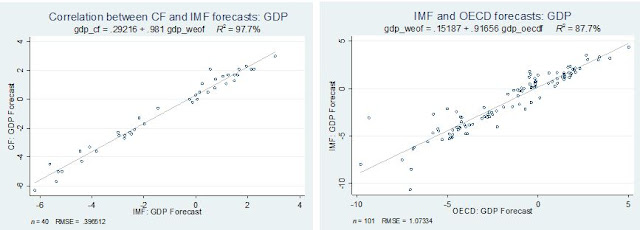
The Stekler Award is named after the famous forecasting expert and academic Herman Stekler who believes that recessions should be forecast "early and often." In practice, recessions are almost never forecast in advance. The Economist recently re-discovered this long-standing finding and highlighted the poor record of the IMF in forecasting recessions. The record of other public institutions or the private sector is just as poor. For instance, see the charts below on forecasts made by the IMF, OECD and the private sector (labeled ‘CF’ in the charts) over the course of 2009—each point shows the forecast for a particular country. The forecasts are virtually identical. And the forecasts for recessions (negative growth) were not made in advance by any of the sources.


The race is on for the 2017 award. Suggestions are welcome and can be sent to ploungani@gmail.com. The Stekler Award recognizes forecasts that depart significantly from the consensus view. Predictions need not be restricted to forecasts of recessions but they must be specific (so "oil prices will rebound someday" doesn't cut it) and well reasoned (so no "we have been on the path to doom which is bound to come one day"-type of forecasts).

We mined a recent article in Politico to see if we could get some front runners for the 2017 award. There were a range of predictions, some quite clever (Dean Baker predicted that during 2016, unlike 2015, oil prices would not fall another $60 a barrel), some specific (Ann Harrison predicts that "India will replace China as the leading destination for foreign investment" in 2016), most quite gloomy. On the U.S. economy in 2016, most experts surveyed stuck to the center, though Robert Reich said: "I expect the U.S. economy to sputter in 2016"; if he'd been a little more specific he 'coulda been a contender'.

Wednesday, January 27, 2016

“Growth is devilishly hard to predict”

Kevin Drum--a political blogger for Mother Jones--asks: "But I wonder who did better at predicting recessions? Goldman Sachs? The CIA? A hedge fund rocket scientist in Connecticut? Whoever it is, it sounds like the IMF might want to look them up."

But as Drum noted in the Economist article, "Despite forecasters’ best efforts, growth is devilishly hard to predict".

Last year, in September, my presentation at the Federal Forecasters Conference summarized my work on the inability or unwillingness of forecasters to predict recessions. I suggested that to get forecasters to predict recessions (even inaccurately) we should have a Stekler Award for Courage in Forecasting. The award would be in honor of noted forecaster Herman Stekler who says that forecasters should predict recessions early and often and that he himself has predicted 9 of the last 5 recessions.

For my recent work on forecast accuracy see the following:

  • September 2015: Fail Again? Fail Better? On the Inability to Forecast Recessions
  • April 2014: “There will be growth in the spring”: How well do economists predict turning points?


Saturday, November 21, 2015

Forecasting: Who keeps the score?

My colleague Hites Ahir has a review and summary of Superforecasting


Superforecasting: The Art and Science of Prediction. By Philip Tetlock and Dan Gardner. Crown; 352 pages; $28.


Here are four forecasts that have been made in the technology field. First: “There is no reason anyone would want a computer in their home”, this was a forecast made in 1977 by Ken Olson—the president of Digital Equipment Corporation. Second: “There’s no chance that the iPhone is going to get any significant market share. No chance”, that was the forecast made in 2007 by Steve Ballmer—CEO of Microsoft. Third: “In five years I don't think there'll be a reason to have a tablet anymore”, forecast made in 2013 by Thorsten Heins—CEO of BlackBerry. Fourth: “Yes, the iPad Pro is a replacement for a notebook or a desktop for many, many people. They will start using it and conclude they no longer need to use anything else, other than their phones”, this forecast was made few weeks ago by Tim Cook—CEO of Apple. In the first three cases, it is safe to say that we know the outcome. In the last case, we will have to wait and see.

Can ordinary people also make forecasts? Who keeps the score of all the forecasts that are made? Why keeping the score matters? What is needed in the forecasting field? Can we do better at forecasting? These are some of the questions that are discussed in a fascinating new book: Superforecasting: The Art and Science of Prediction by Philip E. Tetlock and Dan Gardner. Tetlock is a professor at the University of Pennsylvania and Gardner is a journalist, author, and a lecturer.

The new book by Tetlock and Gardner describes the results from a massive forecasting tournament—the Good Judgment Project—sponsored by Intelligence Advanced Research Projects Activity (IARPA). The idea behind the project was to see who could invent the best methods of making forecasts that intelligence analysts make every day. The participants were asked to make a forecast on different topics. Some of the topics included were: Will OPEC agree to cut its oil output at or before its November 2014 meeting? Will the president of Tunisia flee to a cushy exile in the next month? Will the gold price exceed $1,850 on September 30, 2011? Will the euro fall below $1.20 in the next twelve months? The project recruited a very high number of volunteers. These volunteers came from a very wide range of backgrounds: from retired computer programmer, social service worker, to a homemaker. Below are some of the interesting parts of the book.

Can ordinary people also make forecasts? Here is one example from the forecasting tournament: “With his gray beard, thinning hair, and glasses, Doug Lorch doesn’t look like a threat to anyone. He looks like a computer programmer, which he was, for IBM. He is retired now. (…) Doug likes to drive his little red convertible Miata around the sunny streets, enjoying the California breeze, but that can only occupy so many hours in the day. Doug has no special expertise in international affairs, but he has a healthy curiosity about what’s happening. He reads the New York Times. He can find Kazakhstan on a map. So he volunteered for the Good Judgment Project. Once a day, for an hour or so, his dinning room table became his forecasting center, where he opened his laptop, read the news, and tried to anticipate the fate of the world. (…) In year 1 alone, Doug Lorch made roughly one thousand separate forecasts. Doug’s accuracy was as impressive as his volume (…) putting him in fifth spot among the 2,800 competitors in the Good Judgment Project. (…) In year 2, Doug joined a superforecaster team and did even better, (…) making him the best forecaster of the 2,800 GJP volunteers. (…) This is a man with no applicable experience or education, and no access to classified information. The only payment he received was the $250 Amazon gift certificate that all volunteers got at the end of each season. Doug Lorch was (…) so good at it that there wasn’t a lot of room for an experienced intelligence analyst with a salary, a security clearance, and a desk in CIA headquarters to do better. Someone might ask why the United States spends billions of dollars every year on geopolitical forecasting when it could give Doug a gift certificate and let him do it.”

Who keeps the score of all the forecasts that are made? “More often forecasts are made and then … nothing. Accuracy is seldom determined after the fact and is almost never done with sufficient regularity and rigor that conclusions can be drawn. The reason? Mostly it’s a demand-side problem: The consumers of forecasting—governments, business, and the public—don’t demand evidence of accuracy. So there is no measurement. Which means no revision. And without revision, there can be no improvement.”


Friday, September 25, 2015

The Stekler Award for Courage in Forecasting (Recessions Inaccurately)

My presentation at the Federal Forecasters Conference summarized my work on the inability or unwillingness of forecasters to predict recessions. I also suggested that to get forecasters to predict recessions (even inaccurately) we should have a Stekler Award for Courage in Forecasting. The award would be in honor of noted forecaster Herman Stekler who says that forecasters should predict recessions early and often and that he himself has predicted 9 of the last 5 recessions. If there was such an award, the 2015 award would go to Lakshman Achuthan of ECRI, who called for a U.S. recession in 2012 in September 2011. ECRI recently explained why it made the call, which is worth reading—the link is given in my presentation. In the running for the 2016 award would be Michael Shedlock (“Mish”) who at the start of this year predicted that Canada and the U.S. would slip into recession this year.

Friday, June 19, 2015

Fiscal Forecasting Follies: Private Sector vs. Government

Government forecasts of budget deficits invoke considerable skepticism. A prominent critic is Jeff Frankel who mocks the ‘‘budgetary wishful thinking’’ of many government agencies. Frankel notes that during the 2000s, the U.S. Office of Management and Budget ‘‘turned out optimistic forecasts’’ for eight years in a row; likewise, in 2000, the Greek government projected that its budget deficits would shrink below 2 percent of GDP within a year, a far cry from the outcome of 4–5 percent of GDP. Such examples have tended to be the rule rather than the exception. Private sector forecasters are presumably less subject to the political pressures that governments face. How well do they do? My new paper with Joao Jalles and Iskandar Karibzhanov presents evidence on the quality of private sector fiscal forecasts.
 

Tuesday, February 3, 2015

Persistent Overoptimism about Economic Growth

Since 2007, Federal Open Market Committee participants have been persistently too optimistic about future U.S. economic growth. Real GDP growth forecasts have typically started high, but then are revised down over time as the incoming data continue to disappoint. Continue reading the FRBSF Economic Letter here.

Monday, February 2, 2015

On Groundhog Day, Honoring A Forecasting Giant


This Groundhog Day I want to honor economic forecasters—and one in particular, Herman Stekler—rather than make fun of them, which is what I’ve tended to do on past Groundhog Days. Herman has had a 60-year career in forecasting and is still making predictions on everything that moves, including Super Bowl games. He recalls that the interview for his first job at Berkeley “occurred during the famous NY Giants–Baltimore Colts championship football game of 1959. I was a Giants fan, and when I left my hotel room they were ahead; I forecasted the final outcome incorrectly.”

Herman believes that forecasters should predict recessions early and often: “… the cost of a recession is so great that a forecaster should never miss one … Some people argue that turning points are unpredictable. I disagree. I have never had trouble predicting recessions. In fact, I have predicted n+x of the last n recessions.”

Herman’s colleagues and friends organized a conference on his 80th birthday and the proceedings have just been published in a special issue of the International Journal of Forecasting. The conference versions of the papers are available here.

The issue has an article by Fred Joutz, Tara Sinclair and me, which summarizes Herman’s extraordinary career—the early work on forecasting turning points and why forecasters seem to miss nearly every one of them; the first forecasting assessments of the Fed’s Greenbook forecasts; and much more.


Forecasting is difficult and I honor the people who have to do it. My own interest in the topic was triggered by my awful forecasts for growth in the Asian crisis economies in 1997-98. I have continued my own “astonishing record of complete failure” by completely failing to forecast the recent sharp decline in oil prices. I did call the Patriots-Seahawks outcome correctly.

Tuesday, April 15, 2014

“There will be growth in the spring”: How well do economists predict turning points?

Forecasters have a poor reputation for predicting recessions. This Vox column quantifies their ability to do so, and explores several reasons why both official and private forecasters may fail to call a recession before it happens.

Wednesday, March 19, 2014

IMF Releases Independent Assessment of its Forecast Accuracy

The IMF’s independent evaluation office released its study of IMF Forecasts: Process, Quality, and Country Perspectives. It concludes that “the accuracy of IMF short-term forecasts is comparable to that of private forecasts. Both tend to over predict GDP growth significantly during regional or global recessions, as well as during crises in individual countries.” The study thus confirms the two main findings of my 2001 paper: first, “the record of failure to predict recessions is virtually unblemished,” as I wrote; second, a statistical horse race between private sector and official sector forecasts ends up in a photo finish. My recent work with Hites Ahir looks at the record of professional forecasters in predicting recessions over the period 2008-12, also confirming both findings. The figure shows the close correspondence between Consensus (private sector) and IMF forecasts.


Friday, August 16, 2013

The Stock Market 'Prediction Charade'

"The next time you are tempted to rely on forecasts of experts in making investment decisions, remember these words attributed to Prakash Loungani of the International Monetary Fund: “The record of failure to predict recessions is virtually unblemished.” Read the full story here. 

Monday, June 17, 2013

MAULDIN: Economists Are Totally Clueless About The Economy

From Business Insider:

"In November of 2008, as stock markets crashed around the world, the Queen of England visited the London School of Economics to open the New Academic Building. While she was there, she listened in on academic lectures. The Queen, who studiously avoids controversy and almost never lets people know what she's actually thinking, finally asked a simple question about the financial crisis: "How come nobody could foresee it?" No one could answer her."

"If you've suspected all along that economists are useless at the job of forecasting, you would be right. Dozens of studies show that economists are completely incapable of forecasting recessions. But forget forecasting. What's worse is that they fail miserably even at understanding where the economy is today. In one of the broadest studies of whether economists can predict recessions and financial crises, Prakash Loungani of the International Monetary Fund wrote very starkly, "The record of failure to predict recessions is virtually unblemished." He found this to be true not only for official organizations like the IMF, the World Bank, and government agencies but for private forecasters as well. They're all terrible. Loungani concluded that the "inability to predict recessions is a ubiquitous feature of growth forecasts." Most economists were not even able to recognize recessions once they had already started." Read the full article here.

Wednesday, May 15, 2013

Krugman on “How the Case for Austerity Has Crumbled”


An Excerpt from Krugman’s review in The New York Review of Books

"Neil Irwin’s The Alchemists gives us a time and a place at which the major advanced countries abruptly pivoted from stimulus to austerity. The time was early February 2010; the place, somewhat bizarrely, was the remote Canadian Arctic settlement of Iqaluit, where the Group of Seven finance ministers held one of their regularly scheduled summits. Sometimes (often) such summits are little more than ceremonial occasions, and there was plenty of ceremony at this one too, including raw seal meat served at the last dinner (the foreign visitors all declined). But this time something substantive happened. “In the isolation of the Canadian wilderness,” Irwin writes, “the leaders of the world economy collectively agreed that their great challenge had shifted. The economy seemed to be healing; it was time for them to turn their attention away from boosting growth. No more stimulus.”"

"How decisive was the turn in policy? Figure 1 [see below. Also, read the graph’s corresponding article: The Great Divergence of Policies], which is taken from the IMF’s most recent World Economic Outlook, shows how real government spending behaved in this crisis compared with previous recessions; in the figure, year zero is the year before global recession (2007 in the current slump), and spending is compared with its level in that base year. What you see is that the widespread belief that we are experiencing runaway government spending is false—on the contrary, after a brief surge in 2009, government spending began falling in both Europe and the United States, and is now well below its normal trend. The turn to austerity was very real, and quite large."


"On the face of it, this was a very strange turn for policy to take. Standard textbook economics says that slashing government spending reduces overall demand, which leads in turn to reduced output and employment. This may be a desirable thing if the economy is overheating and inflation is rising; alternatively, the adverse effects of reduced government spending can be offset. Central banks (the Fed, the European Central Bank, or their counterparts elsewhere) can cut interest rates, inducing more private spending. However, neither of these conditions applied in early 2010, or for that matter apply now. The major advanced economies were and are deeply depressed, with no hint of inflationary pressure. Meanwhile, short-term interest rates, which are more or less under the central bank’s control, are near zero, leaving little room for monetary policy to offset reduced government spending. So Economics 101 would seem to say that all the austerity we’ve seen is very premature, that it should wait until the economy is stronger."

------
The Great Divergence of Policies article has also been featured in the Great Recession and Not-So-Great Recovery by the Financial Times, Free to Spend, Developing Economies Recover Quicker by the New York Times, The Non-Secret of Our Non-Success by The Conscience of a Liberal Blog, and How the IMF became the friend who wants us to work less and drink more by the Washington Post.

Sunday, April 21, 2013

Great Recession and Not-So-Great Recovery

From the Financial Times:

This week’s IMF meetings in Washington lacked the sense of crisis which has characterised many such meetings since the crash in 2008. Although the official IMF growth forecasts were revised down slightly for 2013, mainly due to tighter fiscal policy in the US, the organisation also said that downside risks, relative to the central forecasts, had diminished since the October 2012 meetings.

These improved downside risks seem to have stemmed mainly from greater confidence in the financial system, reflecting the budget deal on the US fiscal cliff, and the actions of the ECB to reduce systemic threats to the euro. Global equity markets agree with this: they are up by 13 per cent since last autumn.

There is, however, a dangerous schism between the improvements in financial confidence and the marked lack of improvement in global GDP growth. On this latter problem, the Washington meetings were focused mainly on the weakness of the eurozone, with Christine Lagarde calling for “more investment” in Germany, greater steps towards banking union and bank recapitalisation, and ECB measures to deal with fragmentation in monetary conditions between the core and the periphery. The G20 statement refrained from setting any targets for public debt reduction, which suggests that Keynesian thinking is gaining ground in international policy circles.

The IMF and the US administration are as one on all this, but my impression is (confirmed here by Chris Giles) is that the gap between Washington and Berlin is wider than ever, especially on fiscal stimulus in Germany. There is a marked sense of frustration, but also of resignation, in Washington about the German approach. Plus ça change.

Abstracting from the details of policy in the coming months, it is important not to lose sight of the big picture for the world economy. This was well summarised in a special study on “The Great Divergence of Policies” in Chapter 1 of the IMF’s latestWorld Economic Outlook. Occasionally, a few simple graphs tell an important story:


In the graphs, the red lines represent the current cycle in the advanced economies, the blue lines represent the average of three earlier recessions (1975, 1982 and 1991), and the index numbers are centred on the year before the recessions started. An abnormally deep recession in 2008/09 has been followed by an abnormally weak recovery, so real GDP per capita is now 10 per cent below the levels indicated by previous cycles (Panel A).

Fiscal policy has been tightened everywhere to control public debt, which is much higher than “normal”, so real public spending is about 14 per cent below the cyclical norm (B). With fiscal policy tightening, the whole burden of supporting demand has fallen on monetary policy, so nominal interest rates have fallen to zero (C) and the central banks have resorted to sizeable increases in their balance sheets (D).

Questions About the Not-So-Great Recovery

This familiar story about the dramatic change in the global fiscal/monetary mix raises several questions about the Not-So-Great Recovery.

First, would the global recovery have been stronger if fiscal policy had tightened less rapidly than has actually occurred? Since the short term fiscal multiplier is almost certainly not zero, the answer to this question is clearly “yes”, but it is hard to ascribe the whole of the shortfall in GDP growth to this single factor.

If real government expenditure had performed as normal in this recovery, this would have resulted in spending being about 5 percentage points of GDP higher than it is now, so the fiscal multiplier would have needed to be about 2 in order to explain the whole of the 10 per cent growth shortfall. This seems implausibly high. Furthermore, monetary policy would have been tighter in such fiscal circumstances, and there would have been a somewhat greater (if still small) risk of fiscal crises in some economies. Therefore the Not-So-Great Recovery is not just a fiscal story.

Second, if fiscal policy is not the only factor at work, what else has been going on? Here the primary candidate is surely the collapse and subsequent malfunctioning of the banking system. Kenneth Rogoff and Carmen Reinhart, for all their arithmetical faults, warned that this would be the case, and it has been. Furthermore, the fact that the US repaired its banking system more rapidly than Europe probably explains a good part of the earlier recovery in US private spending in 2012/13. The US/Europe divergence on growth is often attributed entirely to the difference in fiscal policy between the two continents, which means that the difference in bank reform all too easily gets forgotten.

Third, if global fiscal policy is tightening and the European banking sector is still in deep trouble, can a continuation of balance sheet expansion by the central banks produce a stronger recovery? The IMF and its economists seem to be answering “yes” to this question, since they are forecasting much stronger global growth in 2014 and 2015.

But there must surely be severe doubts about this conclusion. Both the IMF and the major central banks are becoming concerned that quantitative easing is causing excessive risk taking in some financial assets, and it is doubtful whether the beneficial effect on the wider economy, via price expectations and aggregate demand, is as powerful as it was at the start.

Conclusion

The IMF’s conclusion is familiar enough: less fiscal tightening should take place in the US this year, along with longer term fiscal reform; root and branch restructuring and recapitalisation of the European banking sector is essential; and monetary accommodation is still needed because it is the only game in town. A familiar message, but this week there was little sign that any of the major policy-makers were listening.

Saturday, April 20, 2013

Free to Spend, Developing Economies Recover Quicker

From the New York Times:

THIS has not been a good recovery for the wealthy countries. Growth has lagged, in part, because government spending has been far more restrained than in past recoveries from major recessions.

But developing economies have been free to increase government spending, and their economies are generally growing more rapidly than they did after past recessions.

The accompanying charts, based on data released this week by the International Monetary Fund in the semiannual World Economic Outlook, show the stark differences in performance.

At the top are charts comparing changes in real gross domestic product per capita in developing countries and advanced economies since 2008, including the fund’s forecasts for 2013 and 2014. In every year, the developed countries have lower growth. The monetary fund forecasts that this year the increase in the United States will be a paltry 1 percent, which at least is better than the forecast for the euro zone and Britain, where declines are expected.

A major reason for the slow recoveries is the absence of fiscal stimulus in much of the developed world. The middle charts show trends in government spending in advanced economies and in developing ones, comparing the trend during the current recovery to an average of the recoveries after three previous world downturns — in 1975, 1982 and 1991. In each case, the figures treat the year before the downturn as zero, and show how earlier and later years differed from that year.

In emerging markets, spending this time has been much stronger than in previous recoveries. But the opposite is true for developed countries, both as a group and for each of the four major regions — the United States, the euro zone, Britain and Japan — that are shown in separate charts.

Those changes reflect the determination to follow a path of austerity in much of the developed world. Many developing countries, having built up foreign exchange reserves in the years before the recession, do not need to follow that course.

The Great Recession brought a drop in world trade volumes that exceeded any decline since the Depression. But as the charts show, the percentage declines were a little less in developing countries than they were in developed countries. And since then, the recoveries have been far more impressive in the less developed countries.

In the euro zone, the total level of imports has still not recovered to 2007 levels, although the International Monetary Fund says it thinks that will happen in 2014. The same is true of exports from Japan, a country whose export prowess once seemed unmatched but lately has been running trade deficits.

Among the four developed regions shown, only the United States has experienced an export revival that is comparable to that of the average emerging market.

Krugman on why this global recovery is different

Krugman uses a graph from Box 1.1 of the WEO. Read the full box here.

Wednesday, April 17, 2013

How the IMF became the friend who wants us to work less and drink more

From the Washington Post:

The International Monetary Fund has a reputation, hard earned over the decades, of being the annoying friend who is always telling you to be more responsible. Eat more vegetables! Put in more hours at the office! Do you really need that second glass of wine?

Similarly, it has historically been the IMF’s role to tell countries to behave themselves economically: Cut those deficits! Let’s see some tighter monetary policy! Do you really need such a generous public welfare system?

But something strange has changed in the world economy, which is evident in the Fund’s latest edition of the World Economic Outlook. The IMF is now among the strongest voices against excessive fiscal austerity and tight money.

The Fund is most direct in its prescriptions for Britain, which has had a stagnant economy for the past three years as deficit-reduction has gone into effect. Sure, the language is that ofinternational bureaucratese (“In the United Kingdom, where recovery is weak owing to lackluster demand, consideration should be given to greater near-term flexibility in the fiscal adjustment.”). But there is no mistaking the message: Hey, David Cameron! Slow down with the deficit reduction! 


Similarly, the Fund worries that the United States is reducing deficits too fast under the sequester spending cuts. “In the United States, the concern is that the budget sequester will lead to excessive consolidation,” says the WEO.
Continue reading the Washington Post article here.

Tuesday, April 16, 2013

Why is the Global Recovery So Weak?

The Great Recession has been followed by the Not-So-Great Recovery. The IMF’s World Economic Outlook (WEO) shows that average incomes in advanced economies are rising, and are projected to rise, at a much slower rate than in past global recoveries. In contrast, incomes in emerging markets are growing at a much faster pace than during past recoveries—see chart 1. The WEO discusses several reasons for this divergence in fortunes. 


Box 1.1 of the WEO notes the divergence in fiscal polices. Government expenditures in advanced economies provided a stimulus at the onset of the Great Recession but withdrew it shortly thereafter. This is in contrast to what happened during past recoveries where government expenditures continued to increase. Again, in contrast, government expenditures in emerging markets have increased during this global recovery as they did in the past—see Chart 2. 

Caution about fiscal stimulus in advanced countries likely reflects the fact that they entered the Great Recession with much higher levels of debt than in the past—see Chart 3.


Box 1.1 does not get into an “an assessment of whether the different policy mix in this recession and recovery was appropriate. The response of policies may have been reasonable given the respective room available for fiscal and monetary policies in advanced economies. But there are also concerns. Even though monetary policy has been effective, policymakers had to resort to unconventional measures. Even with these measures, the zero bound on interest rates and the extent of financial disruption during the crisis have lowered the traction of monetary policy. This, together with the extent of slack in these economies, may have amplified the impact of contractionary fiscal policies. Four years into a weak recovery, policymakers may therefore need to worry about the risk of overburdening monetary policy because it is being relied on to deliver more than it has traditionally.”

Read Box 1.1 from the WEO here for the full analysis.

Monday, January 7, 2013

Growth Forecast Errors and Fiscal Multipliers

A new paper investigates the relation between growth forecast errors and planned fiscal consolidation during the crisis. The authors find that, in advanced economies, stronger planned fiscal consolidation has been associated with lower growth than expected, with the relation being particularly strong, both statistically and economically, early in the crisis. A natural interpretation is that fiscal multipliers were substantially higher than implicitly assumed by forecasters. The weaker relation in more recent years may reflect in part learning by forecasters and in part smaller multipliers than in the early years of the crisis.

Wednesday, December 12, 2012

Seven Questions on Turning Points of the Global Business Cycle

The depth and breadth of the worldwide recession that followed the 2007–09 financial crisis have led to intensive discussions about the phases of the global business cycle—global recessions and global recoveries. The fragile nature of the ensuing global recovery has added a new twist to these discussions because of widespread concerns about the possibility of a double-dip global recession. This article provides brief answers to seven commonly asked questions about the global recessions and recoveries. Read more.